Begin with your music
Tell me what you listen to and why you want to play. A favourite song can give us a clear starting point, whether that means following its pulse, understanding a groove or exploring a fill. Lessons follow your experience and goals rather than a fixed course for everyone.
Your first time behind the kit
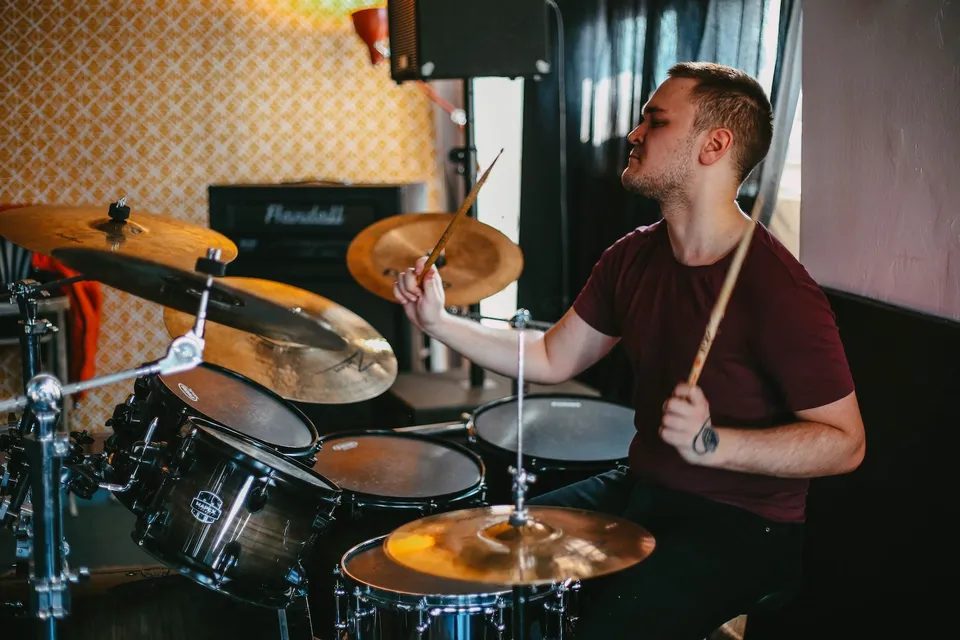
You do not need a drum kit or previous musical experience to start studio lessons. We can look at the parts of the kit, seating and how the hands and feet work together. Start with one clear task, such as a steady pulse, before combining several movements.
Coordination in manageable steps
A pattern can feel complicated when every limb has a different job. We can separate the parts, practise a short phrase slowly and bring them together. The aim is to hear a consistent groove rather than race through a difficult exercise.
Timing and listening
A metronome or backing track helps us explore the space between notes. We can listen for whether a fill speeds up, whether the groove stays steady and how the drum part supports the bass or melody. Silence and dynamics matter alongside the notes themselves.
Reading drum notation
We can connect written rhythms with counting, clapping and playing. Reading is useful for remembering ideas and following arrangements, while learning by ear helps you recognise the shape and feel of a part. You do not need to read music before your first lesson.
Explore different styles
I teach across a wide range of genres, particularly the music students enjoy. We can compare how a drum part changes between styles, explore unfamiliar rhythms and consider the sound and dynamics a song needs. Bring examples of music you want to understand.
Returning and advanced players
If you already play, bring a passage or question that captures your next challenge. We might examine consistency, fills, coordination, a different time signature or playing with other musicians. A clear focus makes it easier to notice progress between lessons.
Optional grades
Grades 1–8 are available as an optional direction. Discuss the examination board, syllabus, entry requirements and any separate fees before choosing this route. Grades are not required to enjoy lessons, and no university points or exam result are promised.
Practice between lessons
Agree a short, repeatable task and a pace at which you can hear what is happening. Make a note of questions and bring them back. If you do not have a kit, discuss suitable practice options rather than buying a full setup before you know what you need.
Choosing your setup
Most lessons take place in my equipped teaching studio on Pershore Road, Stirchley, Birmingham B30 2JF. The full teaching address and arrival arrangements are provided when booking. Please discuss any access requirements before travelling. Online lessons and a limited number of home visits are also available by arrangement. I teach adults and children from age six, from complete beginners to experienced drummers. A 30-minute lesson is usually a useful starting point for younger learners. Include the student’s age when enquiring so we can discuss lesson length, supervision and a suitable starting point.