Explore your next steps
Your guide to learning drums in Birmingham
Practical guidance on getting started, practising and choosing your next musical goal.
01
Your first music lesson on the drums
Find a musical starting point
Think of a song that makes you notice the drums. It might have a straightforward beat, a memorable introduction or a change of energy you enjoy. Bring that example and tell me what catches your ear. We can begin with a small part of it rather than trying to reproduce an entire recording. A useful first lesson gives you something understandable to play and listen for, whether you are completely new or returning after time away.
Meet the kit one part at a time
A drum kit combines several instruments, each with a role in the overall sound. We can explore the bass drum, snare, hi-hat and other parts separately before combining them. Start by hearing where each sound belongs in a simple pattern. There is no need to use every drum and cymbal at once. A clear, repeatable groove gives us a foundation for later changes, and lets you notice how a small adjustment changes the feel of the music.
Build coordination gradually
Playing with your hands and feet can feel unfamiliar at first. We can separate a pattern into manageable parts, try those parts individually and then bring them together slowly. If adding one movement disrupts the rest, that tells us where to focus; it is not a reason to rush through the whole pattern repeatedly. Counting aloud, listening to a demonstration and repeating a short section can help connect the movements with the musical pulse.
Begin without buying a full kit
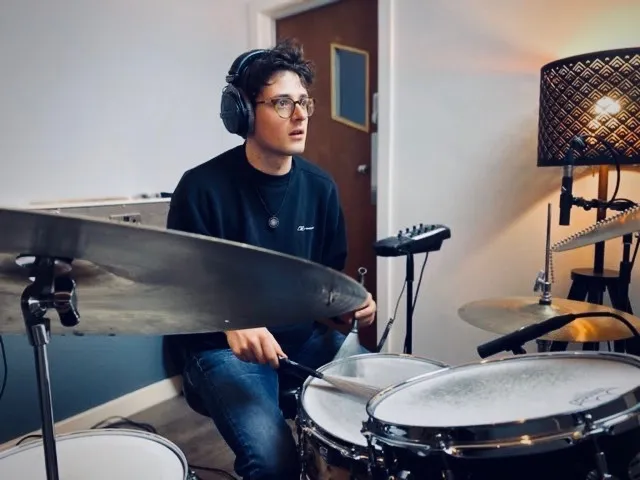
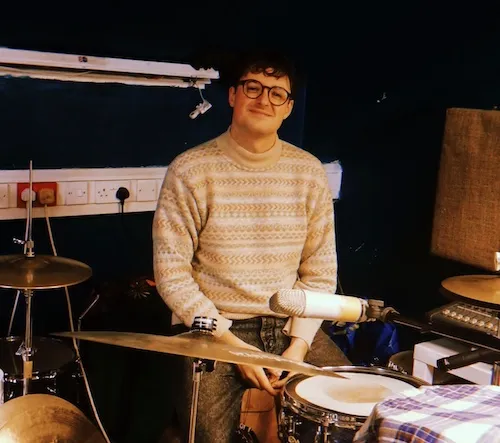
The Stirchley teaching space has a drum kit, piano and full PA setup for lessons, so owning a drum kit is not an entry requirement. Before spending money, consider your practice space, neighbours, budget and what you want to work on. A practice pad, an electronic kit and an acoustic kit offer different possibilities and limitations. We can discuss which option fits the task. Ask about sticks and accessories before buying a large bundle just because it is labelled for beginners.
02
Music theory, rhythm and reading
Keep the pulse through the pattern
A groove works because its parts relate to a continuing pulse. We can practise finding that pulse in a recording, counting a short phrase and keeping the pattern steady when it repeats. A metronome can provide another reference, but the aim is to understand your timing rather than simply play faster. Choose a tempo at which you can hear what is happening. When the pattern becomes consistent, we can explore a gradual change of tempo or a different accompaniment.
Learn by ear with a clear question
Listen to a short section and identify one feature at a time. Where does the snare fall? Is the hi-hat pattern steady, or does it change at the chorus? What happens just before the next section? You do not have to identify every sound immediately. Repeated listening with a specific question is more useful than guessing at the entire part. We can simplify what you hear into something playable, then add detail as it becomes familiar.
Learn to read music and drum notation
Learning to read drum notation gives us a way to remember and discuss a pattern. Music theory and note reading can help explain counts and time signatures through short examples on the drum kit. We can connect a symbol with a sound and a count, then play a short example and hear how it fits. Learning to read music does not mean putting favourite songs aside until you finish a theory course. Listening, notation and practical playing can support one another. Bring any chart you are already using so we can work through the unfamiliar parts in context.
Make fills lead somewhere
A fill can mark the end of a phrase or introduce a new section, but it still needs to arrive at the next beat in the right place. We can start with a short fill inside a repeating groove and practise returning smoothly. Listen to whether the change supports the song instead of judging it by how many notes it contains. A simple idea played clearly can communicate a transition better than a complicated pattern that interrupts the pulse.
03
Practice that supports progress
Leave with one manageable task
At the end of a lesson, agree what to practise and what to listen for. That might be repeating a groove consistently, joining two sections or reading a short rhythm. Make a brief note of the tempo and the particular difficulty. Working on a clear task makes it easier to use the time you have between lessons. If you use practice videos, choose a short example that relates to that task rather than jumping between unrelated exercises. You can bring a question about that task next time rather than feeling you must have perfected everything.
Use repetition with a purpose
Repeat a short passage enough to notice what changes between attempts. If the same transition keeps breaking down, isolate the movement immediately before and after it. Then return to the longer phrase to check whether the work helped. Increasing speed is only one possible goal: you might instead aim for a more even sound, clearer accents or a reliable ending. Keeping a simple practice record helps us see what is improving and choose the next step.
Listen to the rest of the music
When playing with a song, the drum part sits alongside voices and other musical instruments. Listen to how different musical styles change the role of the drummer. Notice how a bass guitar line relates to the beat and where the arrangement leaves space. This is about understanding your role in the music, rather than filling every gap. We can practise maintaining a groove through a verse, responding to a chorus and following a clear ending. These are useful skills whether you eventually play with a band or enjoy practising at home. Your part should make musical sense beyond the individual movements you are learning.
Choose goals that matter to you
You might want to play a favourite song, join other musicians or prepare for an optional grade. What you want to achieve determines the next step; these aims do not require the same sequence or timetable for every learner. Grades 1–8 are available as a structured route, with the board and current requirements confirmed before preparation. You can also continue without exams. Learning music can be about a new skill, a favourite track or the fun of building a repertoire you enjoy. Tell me when your interests change so we can adjust the lesson focus rather than treating the first goal as a permanent commitment.
04
Planning your drum lessons
Choose a lesson length and routine
A 30-minute lesson costs £20 and an hour costs £35. Lessons are pay as you go, with a weekly, fortnightly or another agreed pattern. Younger learners often begin with the shorter option; adults and experienced players can discuss how much time suits their aims. Four hour-long studio lessons would total £140, as an example rather than a package offer. Read the prices and cancellation arrangements, and confirm current availability before planning a regular slot.
Arrange your first studio visit
Most lessons take place on Pershore Road in Stirchley, Birmingham B30 2JF. The full address and arrival instructions are supplied when booking; the general area shown on the website is not an entrance instruction. Discuss access requirements in advance and ask what to bring. Parents arranging lessons for kids aged six or over should include the learner’s age so we can agree lesson length and supervision. There is no need to prepare an audition for your first music lesson.
Discuss online music lessons or home tuition
Online lessons and a limited number of home visits offer alternatives to coming to the studio. Explain your location, equipment and usual availability so we can discuss whether either option is suitable. Home visits may carry an additional travel charge, agreed beforehand. For online tuition, ask about camera position, sound and the platform before the appointment. The aim is to make the format practical for the work you want to do, rather than assuming every setup suits every lesson.
Send a useful first enquiry
Tell me about your experience, the music you enjoy and any specific aim, such as developing a groove, reading charts or preparing a grade. Mention whether you prefer the studio, online tuition or a possible home visit, and include the student’s age for a child. You do not need to know all the answers already. Ask Jonno about drum lessons and we can discuss a starting point, current availability and the practical details before you book.